A practical nutrition guide for skiers, with NOVAFIT gels and bars
In 30 seconds
- Skiing is an endurance sport. Long hours, cold, altitude and heavy gear: your tank empties faster than you think.
- Snow is deceptive: the cold hides thirst and altitude kills appetite. That is why you need to eat and drink to a plan, not by feel.
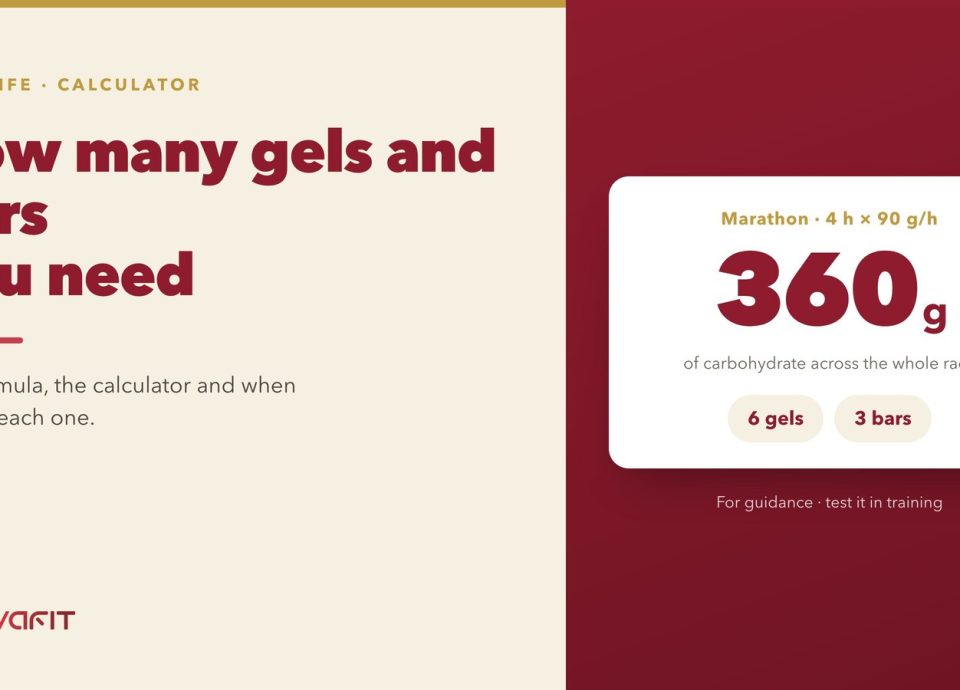
- The key number: 30–60g of carbohydrate per hour for efforts of 1 to 2.5 hours, and up to 90g per hour for longer ones, combining glucose and fructose.
- Steady energy = little and often. Small, regular intakes with well-combined sugars avoid the classic spike followed by a crash.
- NOVAFIT makes the maths easy: one gel provides 45g of carbohydrate from five different sources; one bar, 30g.
Do any of these scenes sound familiar?
It is 11:30, you have been linking runs since first lift and, suddenly, your quads burn on every turn. You stop more often than you should. You put it down to “normal” tiredness.
Or you are skinning up at a good pace and, on the last steep pitch before the summit, you notice your legs no longer respond the same way. You are not hungry, not thirsty… but the engine cuts out.
Or the last run of the afternoon arrives, the one you were most looking forward to, and you get down it with just enough technique, without enjoying it, longing to reach the bottom.
In most cases it is not a lack of fitness: it is a lack of fuel. And it can be fixed. In this article we explain, simply, what your body needs when you ski, what the science says and how to organise your day so you reach the last run with energy, without stomach trouble and without sugar rollercoasters.
Why does the snow drain your tank so fast?
Skiing is not just exercise: it is exercise in an environment that changes the rules of the game.
The cold makes you burn more. Keeping your body warm, moving in heavy clothing and boots and travelling over snow all increase energy expenditure (Meyer et al., 2011). In ski mountaineering, the mandatory race kit can weigh more than 11kg (Praz et al., 2014).
The cold hides thirst. In a study of athletes walking at a moderate pace, cold reduced the sensation of thirst by up to 40%, even when they were already dehydrated (Kenefick et al., 2004). In other words: on the snow you may need to drink and have no urge at all.
Altitude makes it a little harder. Above 3,000 m, maximal aerobic capacity drops by roughly 6% for every 1,000 m, and the dry air makes you lose more water through breathing (Bortolan et al., 2021).
And eating in the mountains is hard. Gloves, cold, pace, few feed stations… Most ski mountaineers eat considerably less than recommended in long races (Praz et al., 2014). It is not a lack of willpower: the environment makes it difficult. That is why you need a plan.
Each discipline, its own challenge
Alpine skiing: the enemy is the clock
It looks like an intermittent sport: you ski down, rest on the chairlift, ski down again. But added up, it is many hours of muscular work, above all for the quadriceps, which brake and stabilise on every turn. That “braking” (eccentric) work is particularly fatiguing (Turnbull et al., 2009).
The typical problem is not intensity but timing: early breakfast, the whole morning on the slopes, a late, light lunch, and back out to ski. The result? Reaching the last runs with the fuel light on.
Ski mountaineering: elite-level endurance
It is one of the most demanding endurance sports there is and, since Milano Cortina 2026, an Olympic sport. In an individual race lasting 1.5–2 hours, athletes hold on average around 93% of their maximum heart rate (Duc et al., 2011).
| Format | Approximate duration | Approximate elevation gain |
|---|---|---|
| Sprint | 3 minutes | Less than 80 m |
| Relay | Less than 15 minutes per team | 150–180 m per racer |
| Vertical | 20–30 minutes | 500–700 m |
| Individual | 1.5–2 hours | 1,300–1,900 m |
| Teams | Up to 3 hours or more | More than 1,800–2,100 m |
Source: Bortolan et al., 2021.
In the long races, energy expenditure is huge. In the Patrouille des Glaciers, one of the most legendary races in the Alps, the participants studied took between 5 and 6 hours and burned around 4,600–5,400 kcal… yet what they ate during the race covered only about 20% of that expenditure (Praz et al., 2014).
The fuel: how much you need and what kind
Carbohydrates are the main fuel for moderate and intense efforts, and the body stores only a limited amount. When the effort lasts more than an hour, taking them during activity is one of the best-supported strategies in all of sports nutrition.
The reference recommendations (Thomas et al., 2016) are clear:
| How long is your effort? | Recommended carbohydrate |
|---|---|
| Less than 1 hour | Usually not needed; small amounts may help if it is very intense |
| 1–2.5 hours | 30–60g per hour |
| More than 2.5–3 hours | Up to 90g per hour |
Two doors are better than one
Imagine your gut has two entrance doors for sugars: one for glucose and another for fructose. If you take only glucose, that door jams at around 60g per hour and the rest is left “waiting” in your stomach, which is exactly when discomfort appears. If you combine glucose and fructose, you use both doors at once: the body makes use of more energy per hour and, in general, it is better tolerated (Jeukendrup, 2014).
That is the principle behind NOVAFIT gels: 45g of carbohydrate from five different sources, with a 1:0.8 glucose-to-fructose ratio:
- Maltodextrin and corn glucose syrup: fast-absorbing energy.
- 100% plant-based fructose syrup: opens the second absorption door.
- Golden Sugar: provides glucose and fructose in equal parts.
- Beet isomaltulose (Palatinose): digested more slowly, it helps energy arrive in a more staggered way within the same intake.
Steady energy: goodbye to the spike and the crash
Have you ever eaten something very sweet when you were truly hungry and, a little later, felt worse than before? That “spike and crash” usually has the same cause: going too long without eating and then taking a lot at once.
The strategy to avoid it is simple and has a lot in common with skiing well: a steady rhythm.
- Little and often. Better a gel or a bar every 45–60 minutes than nothing for three hours and then everything at once.
- Start early. Your first intake between 30 and 45 minutes into the activity, before you feel the dip.
- Combined sugars with different speeds. Mixing fast sources with a slower one, such as isomaltulose, helps spread the energy more evenly.
- Every gel with water. A few sips help digestion and keep your stomach comfortable.
- Train your stomach. The digestive system adapts. If you want to reach high amounts per hour, build up gradually over the season, and never try a new plan on race day.
Your day, moment by moment
These are the questions worth asking yourself through the day, and how to answer them with NOVAFIT.
Had breakfast at 7:30 and the first lift opens at 9:00? By mid-morning your breakfast will already be “spent”. Keep a bar handy for the second or third chairlift.
Is it 11:30 and your legs are getting heavy on every turn? It is the classic moment for the first energy dip. A gel on the chairlift and a few sips of water: you will feel it before long.
Is lunch going to be late, or just a quick bite? A bar bridges the gap between breakfast and a lunch that on the slopes almost never comes on time. Eating something solid helps both mentally and muscularly to reduce the feeling of fatigue.
Taking off your skins at the summit, cold and in a hurry? The transition is your perfect feed stop: a gel in seconds, no chewing, while you pack away your skins.
Facing the last climb of a long tour? This is no time to improvise. If you have stuck to your plan (a gel or a bar every hour), you will arrive with fuel in the tank. If not, this is when the tank usually runs dry.
Heading for the last runs of the afternoon, the ones you enjoy most? This is when fatigue takes its toll on technique. A gel 15–20 minutes beforehand helps you finish the day the way you started it: enjoying yourself. And the journey home? Discover how heading back doesn’t have to be a nightmare. Batteries recharged at the end of the day. And tomorrow? Tomorrow, more and better.
Hydration: drink even if you are not thirsty
In the cold you sweat less than in summer, but you still lose water: through sweat under your technical clothing and, especially at altitude, through breathing. Since thirst is barely noticeable, it is not a good guide.
The good news: with a plan, it works. In the Patrouille des Glaciers, the participants studied finished with a weight loss of around 2%, within acceptable limits, after 5–6 hours of effort (Praz et al., 2014).
- Drink by the clock, not by thirst. Small sips every 15–20 minutes.
- Carry warm fluids. A thermos or an insulated bottle stops them freezing and makes drinking more pleasant.
- Take every gel with water. Although NOVAFIT gels contain a high proportion of fruit pulp, a few sips help.
- In long efforts, don’t forget sodium. The guidelines recommend including it in prolonged efforts (Thomas et al., 2016). NOVAFIT gels include sodium citrate in their formula.
NOVAFIT gels: energy in seconds, when you can’t stop
A gel is the most practical format when the effort is intense or there is no time: on a skin climb, during a transition or mid-race.
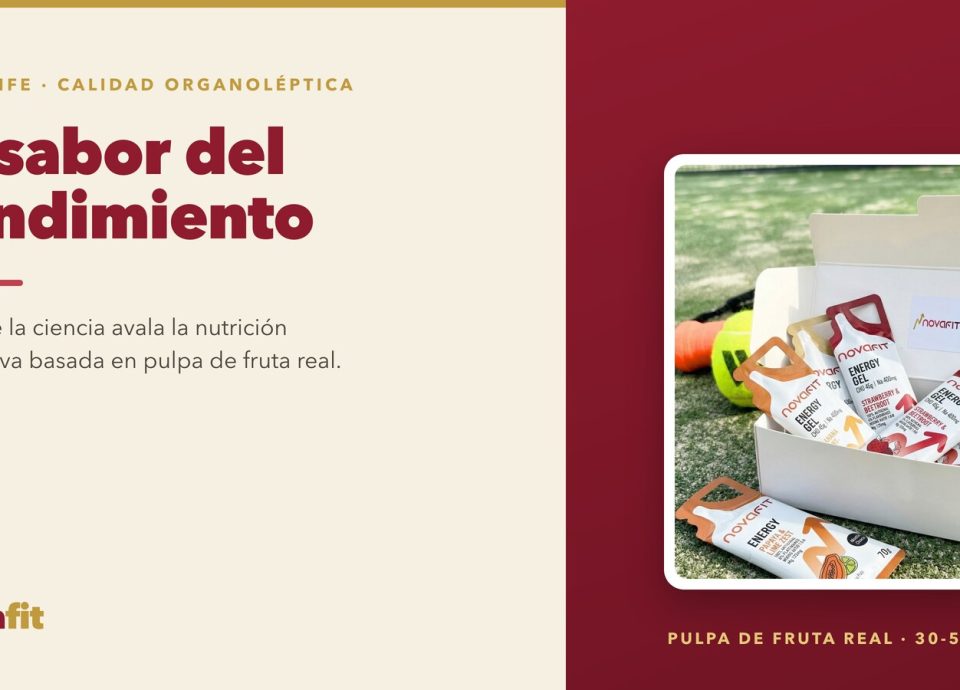
Each NOVAFIT gel (70g) contains:
- 45g of carbohydrate from five sources, in a 1:0.8 glucose-to-fructose ratio.
- Between 30% and 45% real fruit pulp, depending on the flavour.
- Sodium citrate and magnesium bisglycinate.
- Gluten-free, lactose-free and suitable for vegans.
Because by the fourth hour, taste matters
On a long day, the problem is not always knowing what to take, but wanting to take it. Very sweet things become tiresome. That is why our gels taste of real fruit:
- Strawberry with beetroot: sweet and slightly tart, with an earthy background that balances it.
- Papaya with lime zest: tropical, with a fresh citrus touch.
- Banana infused with mint: the classic flavour, with a fresh finish that cleanses the palate.
Switching flavours through the day also helps you not get bored of eating.
NOVAFIT bars: real food for long days
When the day is long, chewing something solid makes a difference, in your head too. A bar on the chairlift, at the summit or during a training break feels like real food, something a gel cannot fully replace.
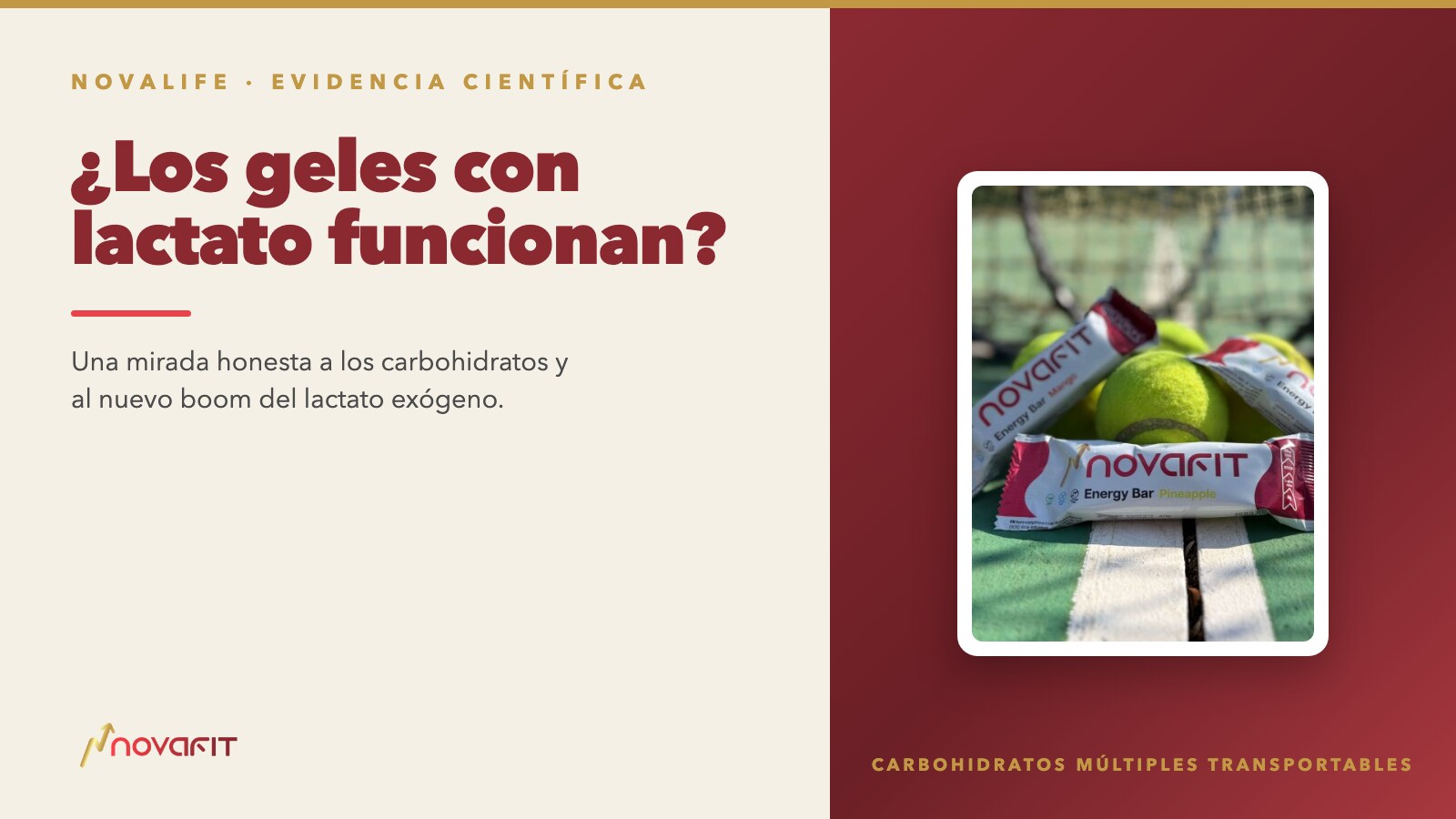
Each NOVAFIT bar contains 50% real fruit pulp and provides 30g of carbohydrate, in a 2:1 glucose-to-fructose ratio.
- In alpine skiing: to bridge the gap between breakfast and a late lunch.
- On tours and long training sessions: when the pace allows you to stop for a few minutes and chew.
- As a partner to gels in the longest races: alternating solid food and gels helps vary textures and add up carbohydrate per hour without relying on a single format.
Your plan, depending on how you ski
Guidelines based on the general carbohydrate recommendations. Everyone tolerates different amounts: try them out in training and, if you compete at a high level, fine-tune them with your sports dietitian.
| Discipline | Typical duration | Carbohydrate target | How to cover it with NOVAFIT |
|---|---|---|---|
| Sprint, relay or vertical | Less than 45 minutes | Not usually needed during the race | One gel 10–15 minutes before the start. |
| Individual race | 1.5–2 hours | 30–60g per hour | One gel per hour; the first at 30–45 minutes |
| Team races, tours and long training sessions | More than 2.5 hours | Up to 90g per hour | One gel and one bar per hour (75g), or two gels per hour (90g) |
| Day of alpine skiing | 4–6 hours, with breaks | 30–60g per hour of activity | A bar mid-morning, a gel or a bar every 1–1.5 hours and a gel before the last runs |
4 tips for eating in the cold (and with gloves on)
- Organise them before you set off. What you will take on each section, in the same pocket and in the order you will need it.
- Turn lifts and transitions into feed stops. On the piste, the chairlift; in the mountains, the skin change.
- Eat before you are hungry. If you wait until you feel it, you are probably already late.
- The mountains have no bins. Keep your wrappers in the same pocket and carry them down with you.
From the piste to elite competition
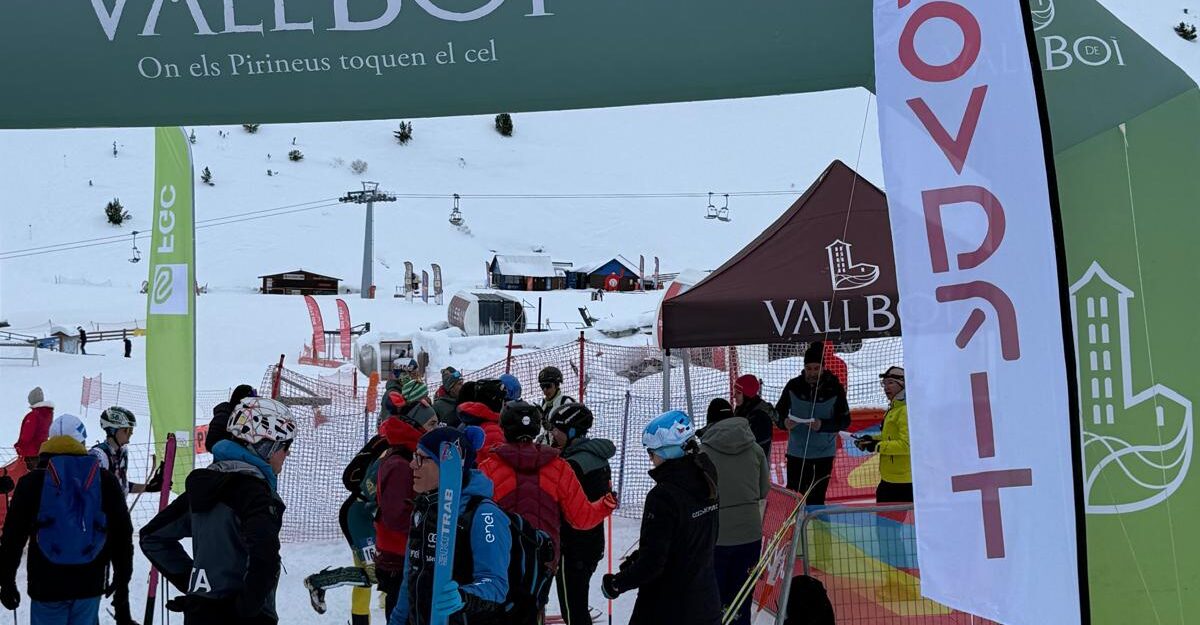
Among those who already trust NOVAFIT are skiers who enjoy a day on the slopes, mountaineers who string tours together and also ski mountaineering federations and national teams. Needs change from one discipline to another, but the idea is the same: well-combined carbohydrates, in a practical format, with natural ingredients and a taste you actually want.
This season, let the sunset be what makes you stop, not a lack of energy.
NOVAFIT. The energy you need, with the taste you deserve.
Bibliography and Scientific References
- Bortolan L, Savoldelli A, Pellegrini B, Modena R, Sacchi M, Holmberg H-C, Supej M. Ski mountaineering: perspectives on a novel sport to be introduced at the 2026 Winter Olympic Games. Front Physiol. 2021;12:737249.
- Duc S, Cassirame J, Durand F. Physiology of ski mountaineering racing. Int J Sports Med. 2011;32:856–863.
- Jeukendrup A. A step towards personalized sports nutrition: carbohydrate intake during exercise. Sports Med. 2014;44(Suppl 1):S25–S33.
- Kenefick RW, Hazzard MP, Mahood NV, Castellani JW. Thirst sensations and AVP responses at rest and during exercise-cold exposure. Med Sci Sports Exerc. 2004;36:1528–1534.
- Meyer NL, Manore MM, Helle C. Nutrition for winter sports. J Sports Sci. 2011;29(Suppl 1):S127–S136.
- Praz C, Léger B, Kayser B. Energy expenditure of extreme competitive mountaineering skiing. Eur J Appl Physiol. 2014;114:2201–2211.
- Thomas DT, Erdman KA, Burke LM. Position of the Academy of Nutrition and Dietetics, Dietitians of Canada, and the American College of Sports Medicine: Nutrition and athletic performance. Med Sci Sports Exerc. 2016;48(3):543–568.
- Turnbull JR, Kilding AE, Keogh JWL. Physiology of alpine skiing. Scand J Med Sci Sports. 2009;19(2):146–155.
This article is for informational purposes and does not replace personalised advice from a sports dietitian.
Article written by the Novafit team.